| Evolution: 12 fret to 14 fret
It obviously happened. Because it's so familiar, let's use the Martin
dreadnought as an example to help understand the phenomenon. And by the way, this is less about blow-by-blow historical detail
than it is about understanding the numbers of frets progression in
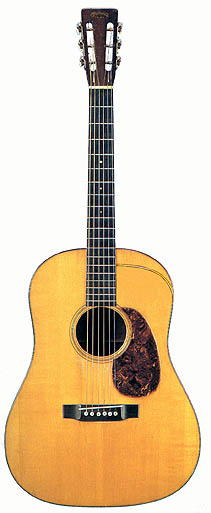
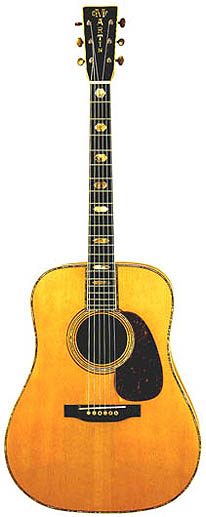
American guitars in the 20th century. Numbers of frets in relation to scale length, in relation to body size. First image is a 1933 D-18. 19 frets, 12 clear of the body. Please note the elegant 4-piece Golden Era top! The second image is what they did to get 14 frets clear: they basically shortened the body... And then in image #3, you see they made the fingerboard one fret longer, moving the soundhole and pickguard closer to the bridge. That's about it.
Basically: smaller top, less air volume. Change of tone?
Certainly. What does it really mean? You be the judge!
OK, now here's what else they might have done to get 14 frets clear of the body. 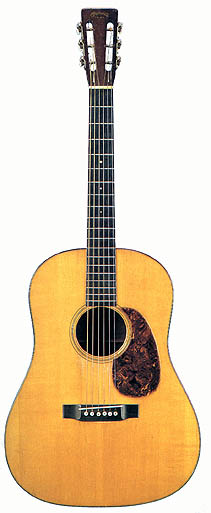 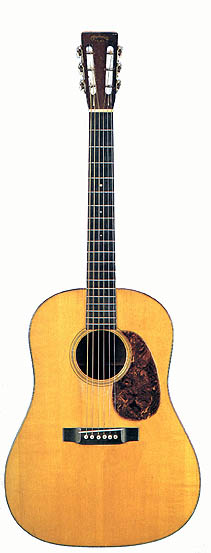 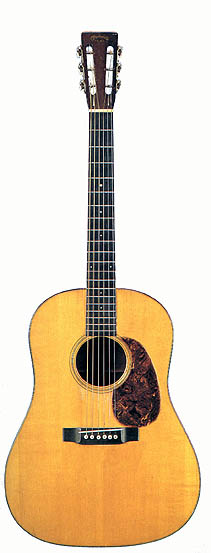 Again, the left image is our old friend, the '33 D-18. (All these
employ the same scale length.) In the middle image, we see an imaginary D-18 (thanks, Photoshop!)
where the
fingerboard, bridge and soundhole are all moved north far enough to
reveal
14 frets. Body is unchanged. It looks rather odd, eh? Kinda like a Gibson J-50, I'd say.
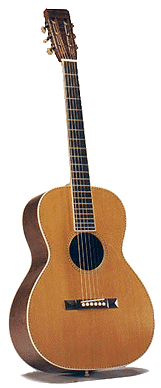
See below. The image on the right shows a board with one more fret, with the soundhole and pickguard moved somewhat south. This is what Gibson did to make their original Jumbo guitars like the J-45 and the SJ. Ironically, Martin recently offered a 14-fret slope-D, copying Gibson's remake of their own guitar from 70 years earlier! Consider the tonal effect of the placement of the bridge closer to the waist of the guitar, regardless of brace position underneath, which as another discussion. These same principles also applied to Martin's 12-fret 000 as it evolved first to the OM (14 fret with the original 000 scale of 25.4") and then to the eventual 14-fret 000 which had a 24.9" scale.
|
|
These same principles applied as well to numerous Gibsons, who had been dabbling with numbers of frets clear of body for some time already. But Gibson entered the Big Guitar market by simply copying Martin's earliest dreadnought, calling it the Roy Smeck model: 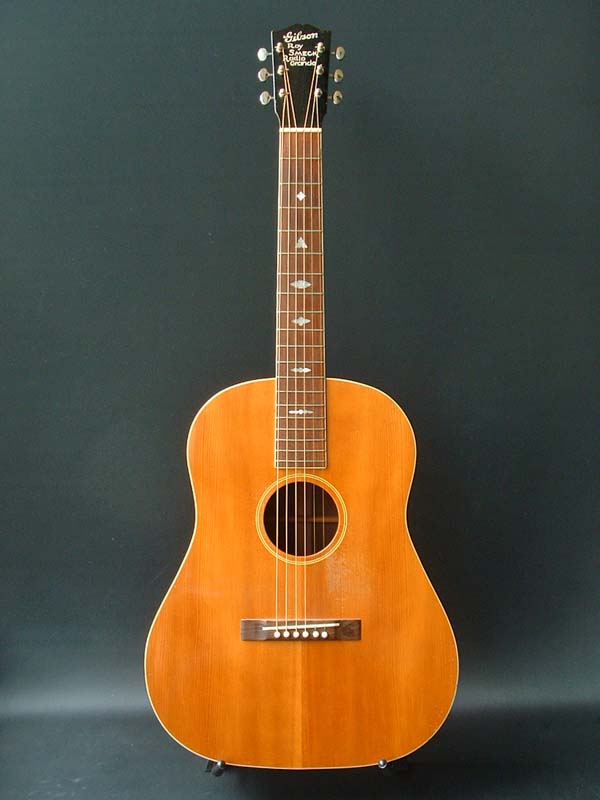 They soon amended that by moving the soundhole and bridge up to make room for 14 frets, but they did not shorten the body: 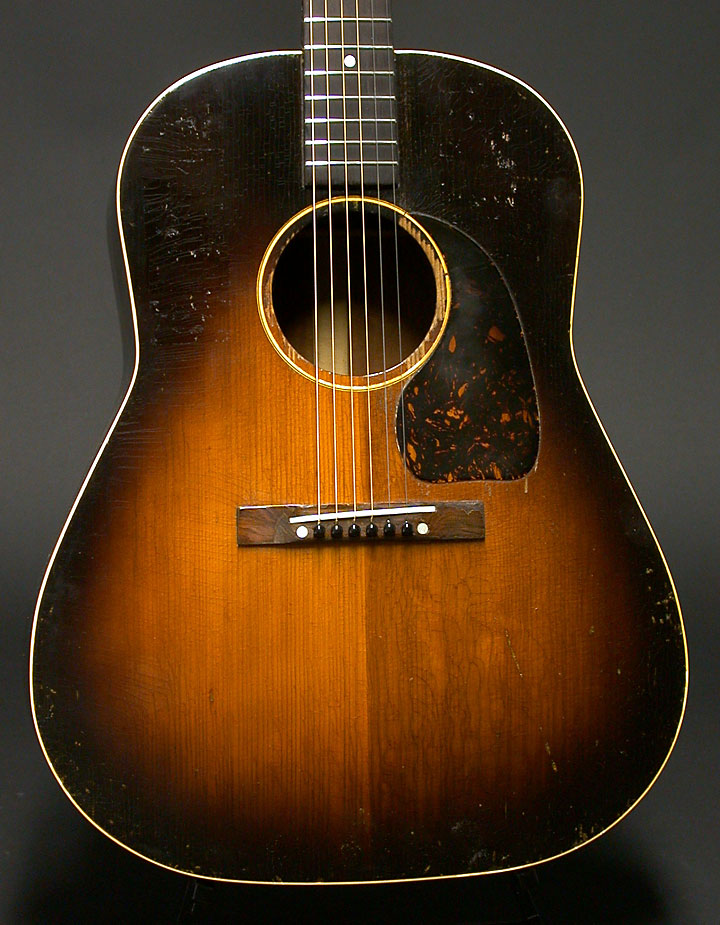 |
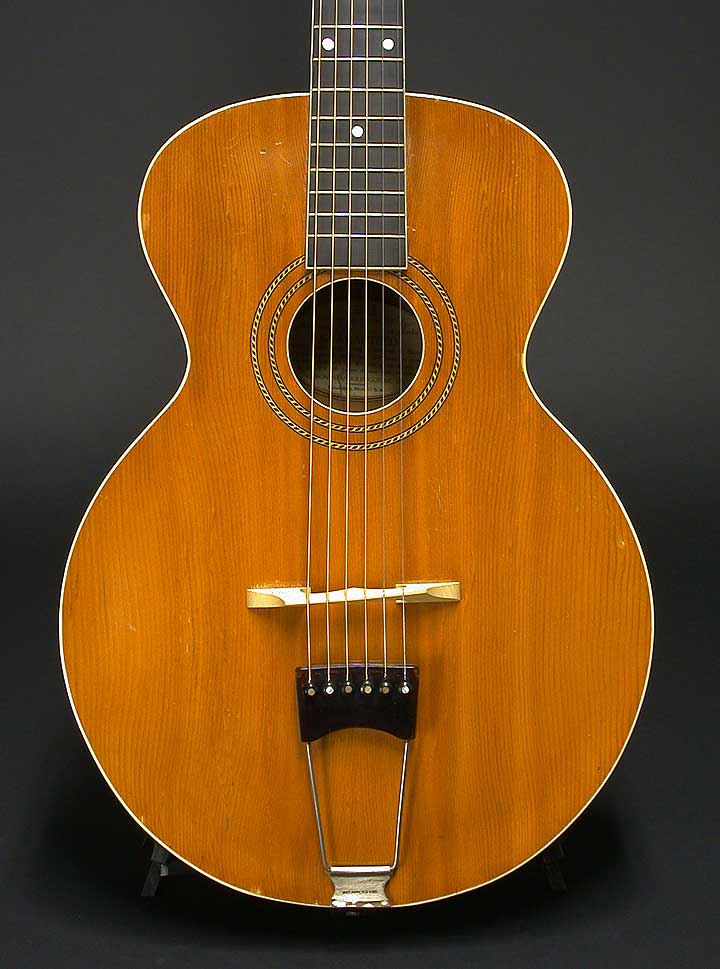
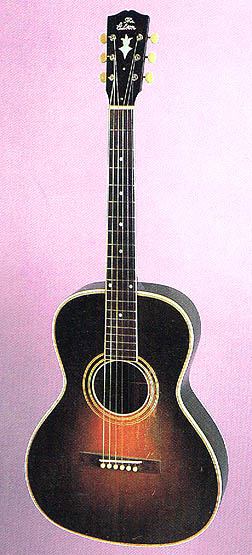
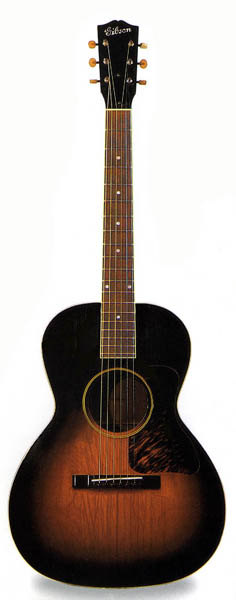
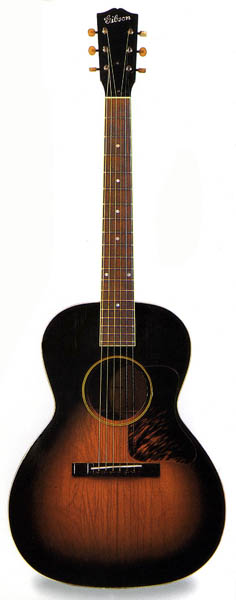
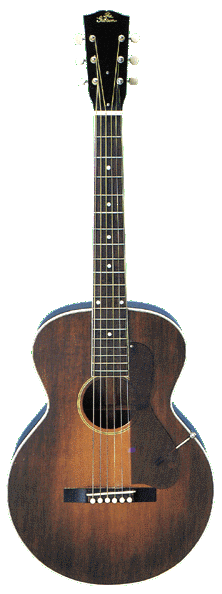 because they had always had some 13-fret models, Gibson made some 13-fret transitional versions of their smaller flattops, and like the dreadnoughts (which they relabeled Jumbos), by and large always kept their scale at 24.75". Here, to the right, is one of Gibson's earlier true flattops, a
1929 L-1. 19
frets,
12 frets clear, 24.75" scale. Check the bridge placement, check the
soundhole
placement. The first Nick Lucas Specials were based on this model,
ironically
known now as the Robert Johnson guitar. These guitars might have sounded good if they had been braced
differently.
As it was, they were generally unremarkable. They usually had two
longitudinal
tone
bars, much like the bass bars in violins. It was a sound, but not a great
sound. A few were x-braced and sounded much richer. A topic for a separate discussion.
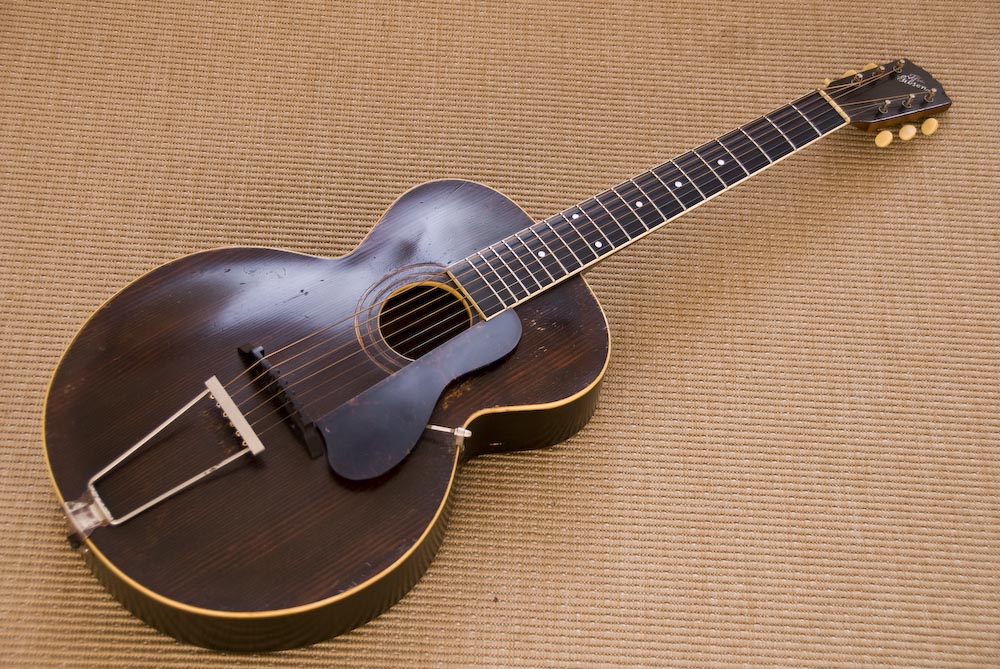
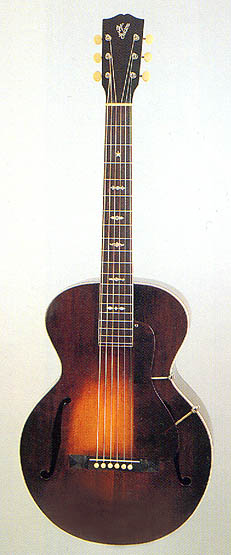
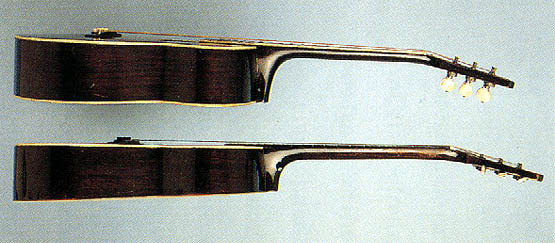
Remember that Gibson started with archtops, and only gradually
moved into
the flattop realm, hence the elevated pickguard. The flattop (above
right) was based on their earlier archtop guitars which had 13 frets
clear of the body! The L-2 (above left and below) was a fully carved
guitar and would have had a pickguard when it came from Kalamazoo.
These guitars were analogs of Gibson's mandolins of that era.
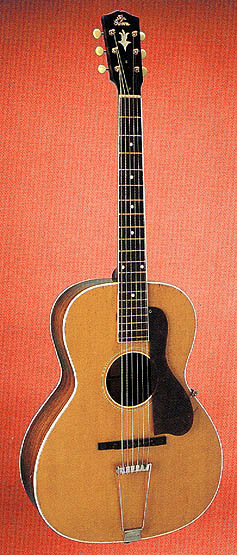
Here's a 12-fret predecessor to the flattop L-1 above, a 1928
Nick Lucas with a
shortened
19-fret board, and f-holes in a flat top. Note the even lower bridge
placement, below
the wide spot at the center of the lower bout, which indicates a longer
scale (not sure what it is though). |
|
Remember that the only real difference between a Nick Lucas and the other production Gibsons of the day (aside from decoration) was the body depth:
Another Martin model was their 00 "Women and Music" guitar, the
00-16DB
(as in:
Deep Body), introduced at NAMM in 1997 and sporadically offered in a
variety of woods with their "custom
classical wooden mosaic rosette," which, alas, was visually rather
overpowering.
This guitar was originally released with a spruce top, dedicated to "Women In Music." It was
effectively
their version of the Nick Lucas. Have a look at one here
if you like. Since then, Martin has offered some variations, such as
this more restrained-looking Jeff Tweedy 00-DB in mahogany, at right.
I think I prefer the original 12-fret 000 for both sound and aesthetics. 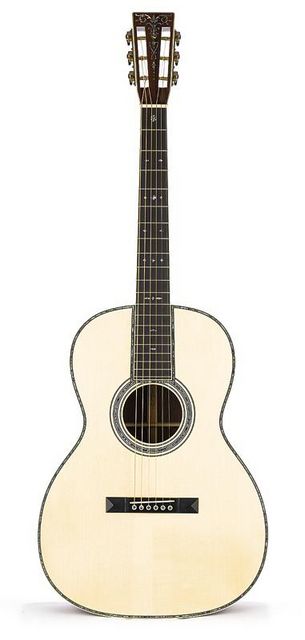 |
| Here's an interesting comparison between two fairly similar
old Gibsons,
both called an L-2.
The first one, from 1931, has 12 frets, and represents (to me) the epitome of this model: bridge and soundhole are absolutely correct. This is an odd photo, somewhat foreshortened. The tailpiece model to the right has 13 frets, so the bridge is moved up - but the soundhole location remains the same. Check the distance between the end of the board and the soundhole. (I own a 13-fret Nick Lucas that evidently once had a tailpiece on it, but never a pickguard, and the pin bridge is factory original. It dates to 1929, and like this one is rosewood.) The point here is that Gibson gained more frets clear of the body by moving the bridge and the fingerboard north. |
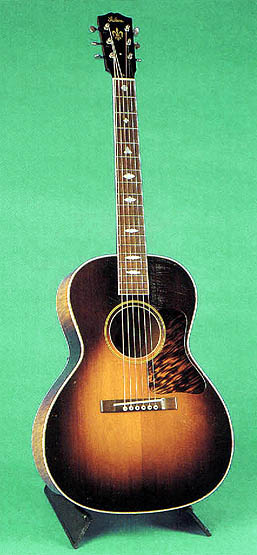 Here's another example, the end of the line for the Kalamazoo Nick Lucas guitars: 14 frets, same old 24.75" scale. See how the bridge is even closer to the waist now, and the soundhole is pushed up. The Montana Nick Lucases have been different: some have a 25.4" scale and 14 frets. |
| Now here's the Gibson progression - a little tidier than it actually was, of course.
Does this have an effect on the sound? I think it does.
The SCGC Model H is my attempt to combine the optimal bridge and soundhole location of the 12-fret with a 25.4" scale, which I think sounds better and is easier to tune. The result is a 13-fret neck guitar. Read more about that here. |
|
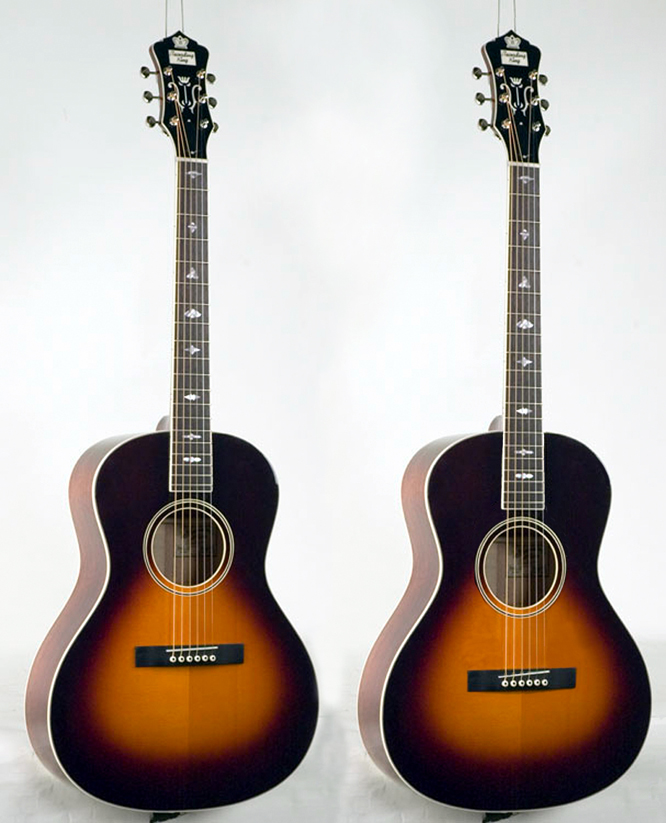
Here's a guitar I'd like to see
happen. The 14-fret with the 24.75" scale exists; the 13-fret with the
25.4" scale needs to exist!
 Q: So why did some of the early flattops have such short scales? Why did Martin convert their 000 from a 25.4" scale to a 24.9"? A: Simple. The longer scales carried over from the era of gut strings. As makers went to steel strings (Gibson was well ahead of Martin on this one) the engineering had to change, and so did the scales. Until the mid 1960's, all steel strings were basically mediums and heavies. There was no light (or extra-light) gauge. String sets came with a choice of an .018 B string that was wound or plain. Let that settle in for a bit. So a shorter scale made the strings easier to play. A case in point is Martin's 000 models which originated with a 25.4" scale, and a 12-fret body. See above. When they first converted the 000 to a 14-fret body, they called it an OM, and it retained the 25.4" scale. Soon they discovered players were finding the long scale a bit too much of a handful with the beefy steel strings then available, and they reconfigured the model with a 24.9" scale. And dropped the OM appellation as well. It was just a 000 again. Today the short scale is back again, partly to meet the needs of people who need the frets closer together for playing ease, partly for the softer sound that comes with lower tension. It may also be a nostalgia thing. Ultimately people like guitars that kick butt, and no 24.75" or 24.9" scale guitar will really do that the way a 25.4" scale guitar will. The longer scales also help improve intonation. But it's grand to have choices. |
 More
on this if anyone is interested. Drop me note if you are. More
on this if anyone is interested. Drop me note if you are. |