|
- History - more about the Model H-13 | pictures of some of the Batch of 15
Starting at the beginning, early in 1978. . . This was not supposed to be a Nick Lucas reissue, although my
initial idea
was to make an improved version of the old Nick Lucas,
which was a 00-size guitar with a deep box and the wallop of a
dreadnought.
At the time I first pitched this idea to my pals at SCGC, in 1978, Gibson was down
for
the count and the model had been extinct in the wild for over 40 years.
I proposed this—and the model F, based on the Gibson J-185, another
extinct guitar—to SCGC in
1978
(when it was still a 3-way partnership: Richard Hoover, Bruce Ross and
Bill Davis) and they went for both of them. At the time they were only
building
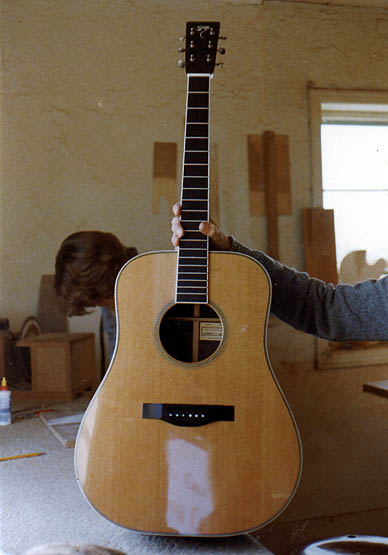
14-fret dreadnoughts. Three were built on this model early that year. All three of those were from a mold that had come out a tad too small. After some consideration, I balked and a new mold was made and we started over from scratch with H-4, which I also kept. The original three were from 1978, and the second batch hatched gradually from spring into early summer of 1979. Here's the very first H-model, 12 frets: 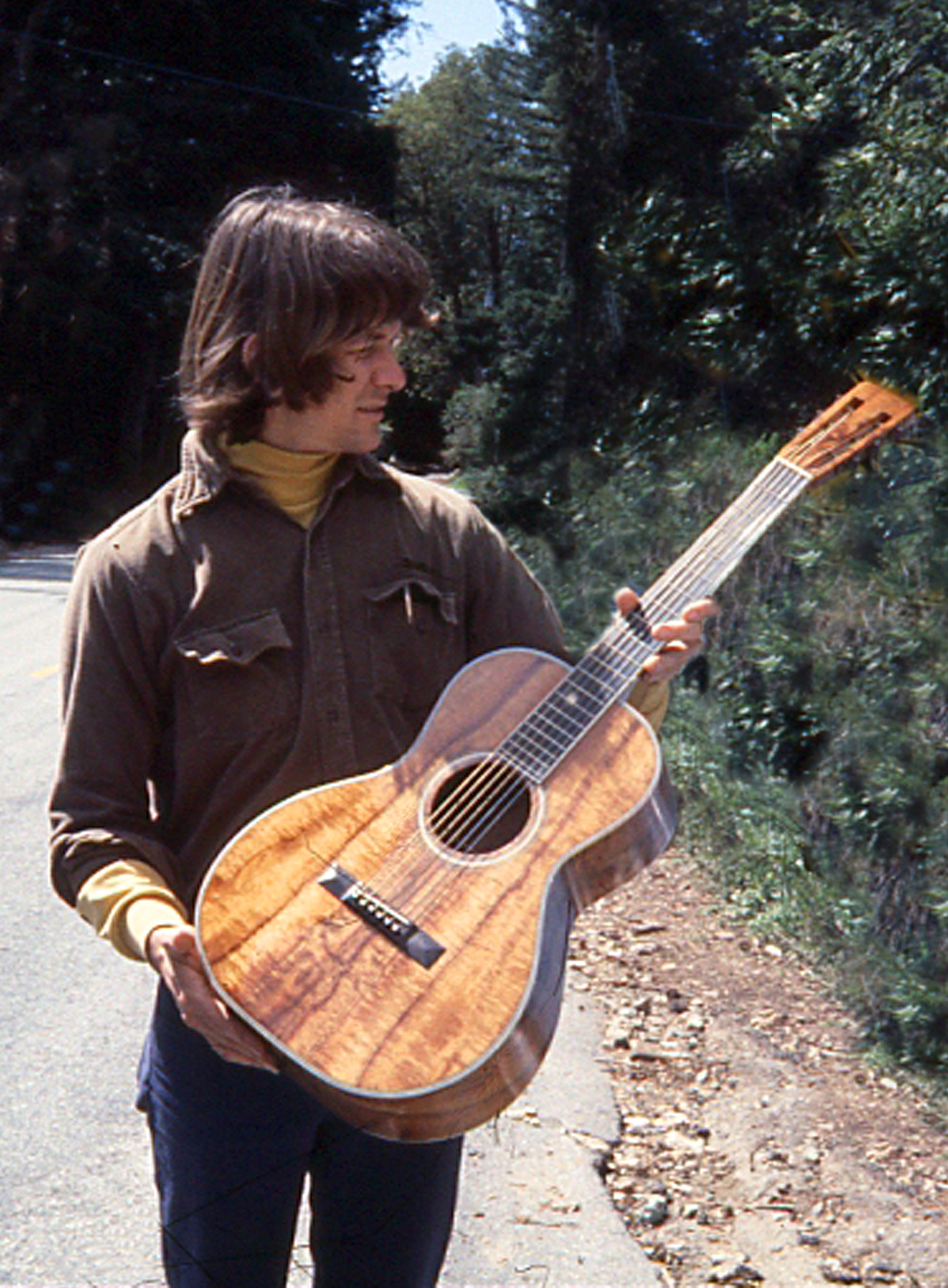 My favorite Nick Lucases had all been 12-fret ones but, preferring a longer scale, and having a chance to try one in the 1978 batch, I ultimately redesigned the guitar around the 12-fret bridge placement but including the longer scale. The eventual result was a 13-fret guitar. The longer scale gives more tension, more brilliance, and makes intonation much better. The extra body depth colors the sound in a different way. The next six from 1979 that I was involved with, H-4 and sporadic numbers up to H-13 (the serial number, not the current model name), were all made in different materials: The idea was to compare materials, all else being the same. The Brazilian rosewood/European spruce was deemed the best of the batch at first, but the tortoise that won the race was the one of bigleaf/Sitka. SCGC made production 13-frets for about a year, maybe 15 or 20
of
them
(Rick Ruskin played one he bought new from the Fret House in Covina;
see
below), then changed everything. The reasoning at that time was that
14-fret
guitars were easier to sell (true) and so, following the example of
Gibson in the 1930s, the model was modified by moving
the soundhole up the body, and the bridge closer to the waist. The body
was also made shallower, to fit easily available cases, even though it continued to be described in
sales literature as having a deep body. It became just a nice 14-fret
00-size guitar.
The label for the prototype run of 1979
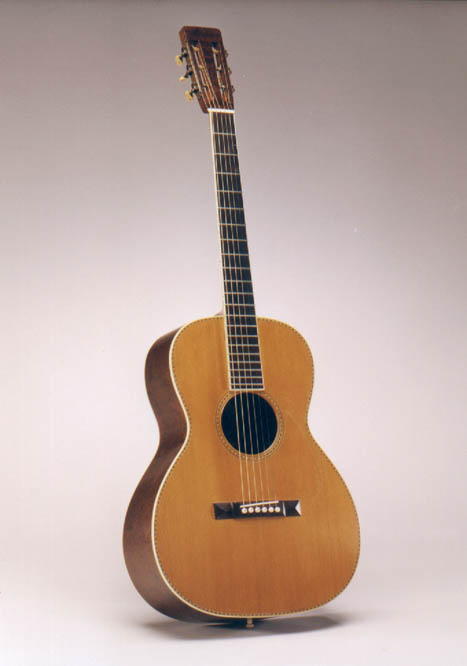
Here's a photo of one of the 1979 production ancestors: That said, they made maybe 25 custom 13 frets with the true deep bodies during the 80s and 90s. People liked the sound of that original design, which is part of why Richard was finally willing to go back to it. There was a reason for 13 frets, the depth, and the layout of the top!
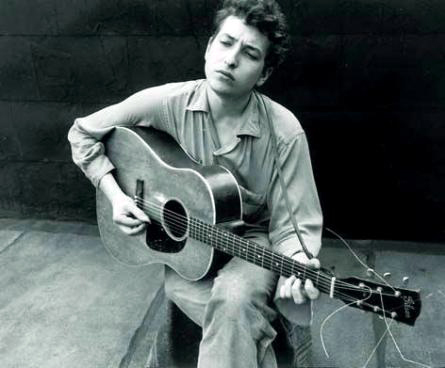
What is different between my original H-4 and the now-revived model H-13 and all the other Model H guitars that SCGC has made all those intervening years? Primarily the bridge and soundhole placement, and body depth, as mentioned. The amended shallower 14-fret model is a fine guitar, no doubt about it. It also makes a fine 12-fret, as with the earlier Gibson L-00. The bridge design is not terribly important, none of the aesthetic details are. A great many have been made a cutaway acoustic-electrics, and they are terrific. But I remain devoted to the sound and aesthetics (in that order) of the deep 13-fret model. How did I get into this guitar in the first place? Here's the reason...but it's not Bob.
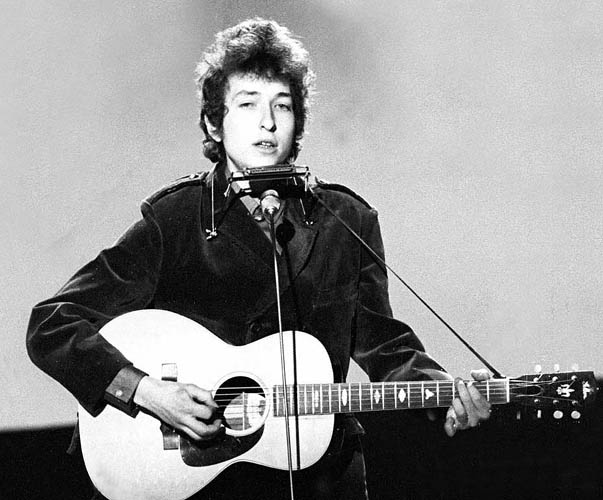
Dylan on TV in 1964
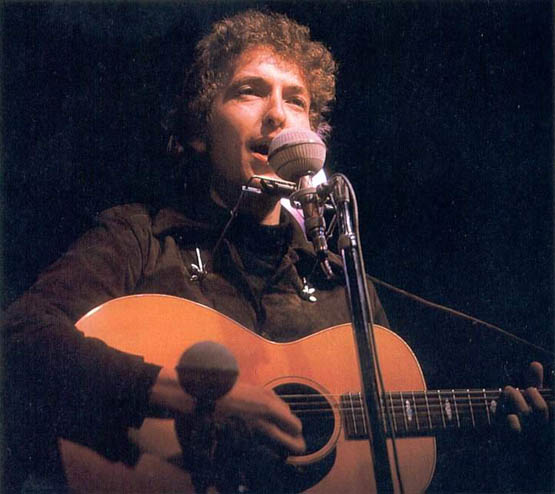
Dylan at Newport 1964 This guitar, serial number 87898, was sold to Bob Dylan by my
friend Marc Silber at
his
shop,
Fretted Instruments, in NYC sometime in 1963. It replaced Dylan's old
Gibson
J-50, which was, Dylan told me personally, lost in action. It's a 13-fret rosewood Nick Lucas that
had been
refinished blonde, and had had a Guild-type bridge and a Martin-type
pickguard
put on. It had earlier belonged to Marc's sister Julie. Marc and Julie
and their family are old friends of mine from Detroit, and I knew this
guitar In January of 1964 I saw Dylan perform again in Denver, and he
played this
guitar. He stopped by the Folklore Center (where I worked then)
after-hours
the next day, and he told me that the J-50 had gone missing, but I
never
connected the fact that the new guitar he'd played the night before was
Julie's old Nick Lucas. It was a mongrel but it sounded
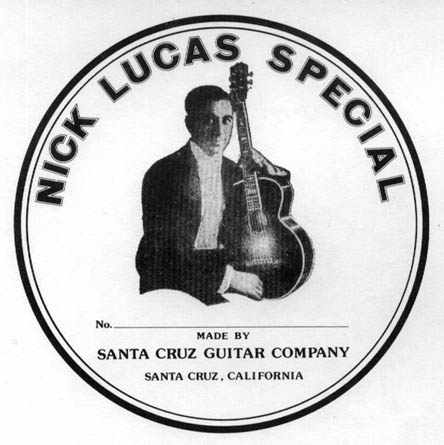
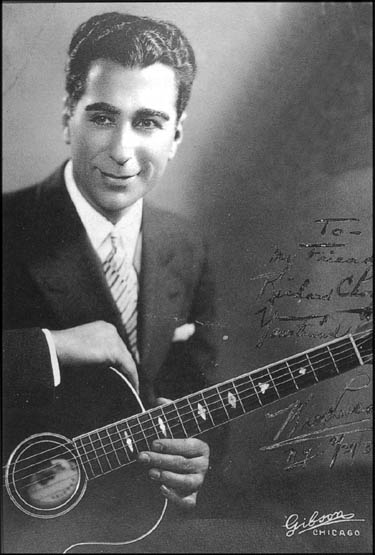
great. I have one just like it myself, photo here. Here's Nick Lucas with a couple of the real early Nick Lucas models:
12-fret dot neck, with babes; I like the rather demented-looking gal clutching his leg.
|
|
12-fret full-fledged "star endorser" model, with Galliano inlays and the later label Note that this guitar is an entirely different model than the later one upon which the SCGC Model H was based. It evolved from the rounder L-1 that's today commonly known as the "Robert Johnson" model. Nick Lucas told me that it was the only model he ever played, though he's pictured playing a variety of them. The one he was playing when I met him in the mid-1970s was a 14-fret model which he said had been his guitar from the very earliest days, that Gibson had worked over and dolled up for him. If this is true, they re-necked it as well. This guitar is allegedly one of the all-rosewood ones Gibson built. That's right: tops, sides and back: Brazilian rosewood More about that here.
|
| Nick said he loved the later
model, was honored that Gibson named a guitar
for him, had given away quite a number of them to students and friends,
but had always stuck by his original one because he never found a
guitar
he liked as well. It was indeed very loud, and even in his sunset years, his playing was
astonishing. |
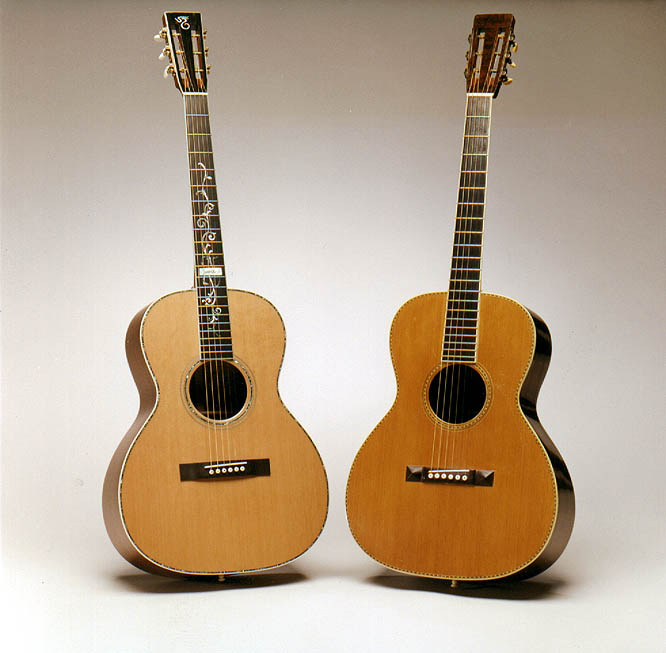
| In January of 2002, the Santa Cruz Guitar Company made a
model H to
about 99% of my original specs as a 25th Anniversary model. It was
presented
at the NAMM show in Anaheim as part of a trio of instruments that
all went to a dealer in Hawai'i named Kelvyn Evans. I was extremely delighted and honored
that
Richard Hoover decided to include le modèle H in that
offering,
whilst bringing it back to being the guitar I had originally envisioned
back 1978.
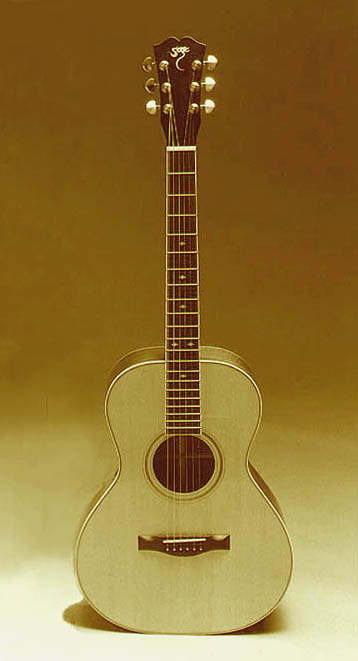
This is the template for the model now known as the H-13.
Seizing the moment, I realized I might have one shot at seeing a short run of these guitars made for me and some friends where I could bird-dog a few details such as fingerboard overhang, saddle angle and intonation stuff, darts and minor aesthetic things. The point was to get a batch through with a particular eye for detail, and hopefully do some R&D work for SCGC in the process. More about the Batch of Fifteen of 2003
more about the Model H-13 | pictures of some of the Batch of 15 (several pages) |
 before
Marc sold it to Bob Dylan. (Julie also turned me on to some
78s
of Nick Lucas playing his guitar - he was a crooner and the hottest pop
guitar icon of 1925. He was also an astounding guitar player). It was a
lovely guitar in all ways, and kindled my enduring interest in the
model,
well before Bob Dylan ever laid eyes on it. The first time I saw Bob Dylan perform
live, in Ann Arbor before his first album was out, he was playing that
old J-50, the one on the cover of his first album.
before
Marc sold it to Bob Dylan. (Julie also turned me on to some
78s
of Nick Lucas playing his guitar - he was a crooner and the hottest pop
guitar icon of 1925. He was also an astounding guitar player). It was a
lovely guitar in all ways, and kindled my enduring interest in the
model,
well before Bob Dylan ever laid eyes on it. The first time I saw Bob Dylan perform
live, in Ann Arbor before his first album was out, he was playing that
old J-50, the one on the cover of his first album. 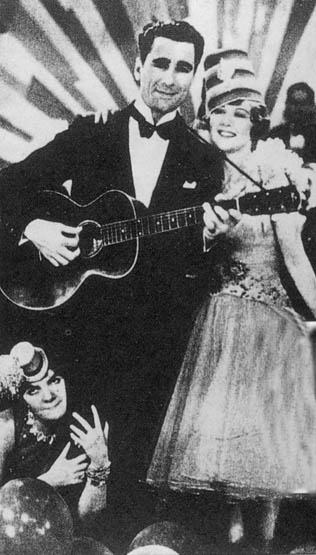
 Questions?
Questions?
Questions?