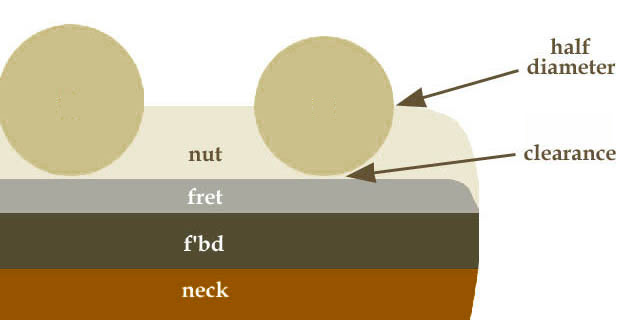
| Nut slots ...with principles that apply, as appropriate, to bridge slots as well Here's a gnat's-eye view at the face of a nut as seen from the leeward side of the second fret. The slots for these two strings are cut so that they completely support the string.
The sketch above
relates to fretted instruments, but the basic
principles are no different for violin family and
other unfretted instruments. I'll try to explain the
clearance in a minute. Here's an idea of
how it works on a bass:
Here's a
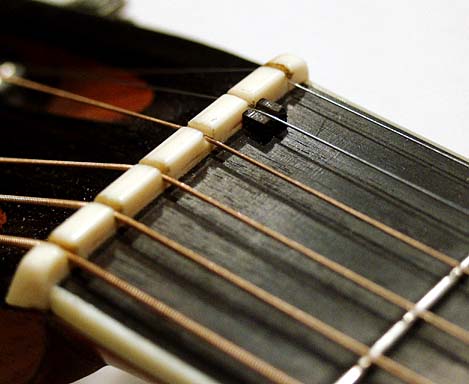
shimmed-up mess of a nut that has all the problems:
These slots are all too deep, but the B is still so high it doesn't play in tune, so someone shoved a piece of ebony under it to try and correct the intonation. Big "Ugh" for this one. People often
comment on certain strings (e.g., mandolin A
strings, guitar G strings) being more troublesome,
always seeming to go out of tune during play.
Mandolin A's are always the most troublesome because
they have to make compound bends from the nut: back
as well as to one side. And the length from the nut
to the post being the other important factor. And
being plain strings, they tend to bind if the slots
aren't cut right. (The D's, being wound, tend to
refine their own slots.) When you tune, you always tune up to a note, never down, right? Right. It's about friction in the slot. And with a poorly
cut nut, when you tune up, the tension on the length
of string between the nut and the string post is
greater (per unit of length) than the part you
actually play, that's between the nut and the
bridge. After getting the pitch just right, a bit of
actual playing works the string, making the tension
on both sides of the nut equalize, and voilà: you're
out of tune in mid-phrase. It has nothing to do with
the tuning machines, which people just love
to blame, but everything to do with setup,
particularly how precisely the string slots at the
nut are cut. A quick word
about creaking guitar G strings: this issue is
fading as elephant ivory nuts are fading. Bone is
superior to ivory for a nut material because it's
harder and burnishes better. Ivory is soft and
actually registers the imprint of string windings.
That irritating creak is the sound of the windings
skidding over grooves impressed inside the nut slot.
Once again: setup is everything. (You can resurface
string slots in an ivory nut by inlaying bits of
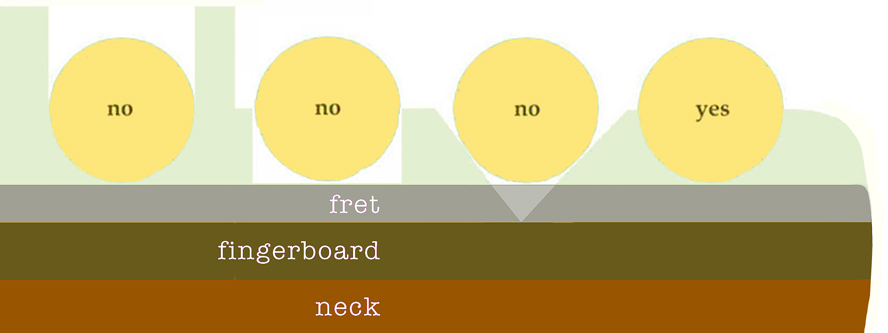
with pearl or bone, if you like.) How do you easily determine the ideal height of the string slot in the nut? OK, start with ⓵: 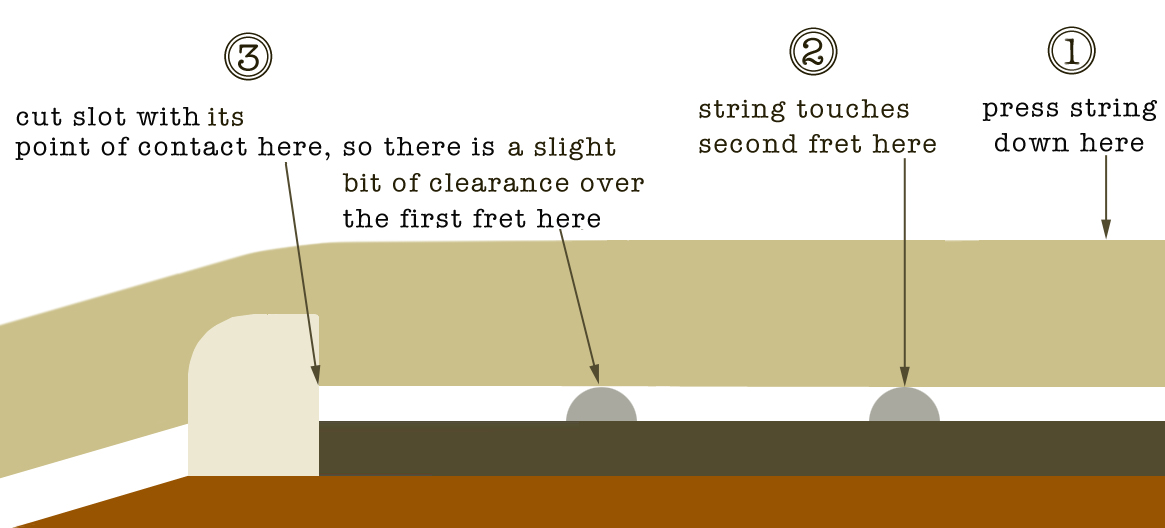
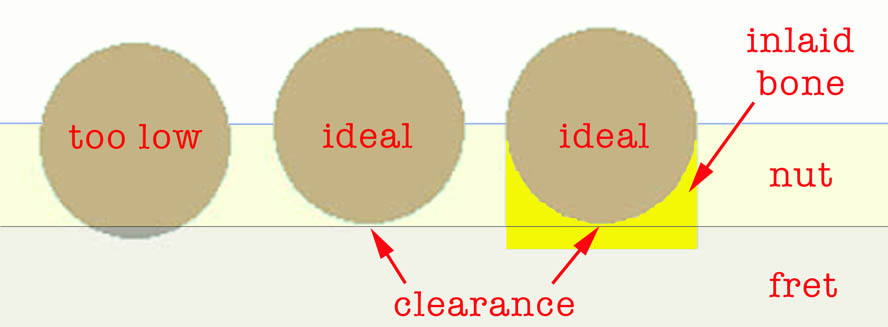
The sketch below
illustrates how - and how not - to shape a slot for
any string. Left: like the
messy nut above, the nut material is too high. You
need only enough to support half the diameter of the
string. Anything more is just in the way. When the
string is way below the top of the nut, you have
great difficulty telling whether it's seating
properly. Next: a slot that's cut with a saw has a roughly flat bottom and also affords poor acoustic coupling. Saws seldom match the precise width of the string, which can roll side to side in the slot. Next: strings
will work their way down a v-cut, often bottoming
out on frets (or the board, as the case may be with
fretless instruments). The signal transfer is
compromised because of the limited contact, and the
string sizzles on the fret or the board. They also
tend to bind and squeak. They can ruin your day. Right: the slot
really fits the diameter of the string, the nut
material does not go above the halfway point of that
diameter, and leaves the string a trace of clearance
above the fret or the unfretted board surface.
How much is a trace? I'm reluctant to assign a measurement—it's very little. You can still see a bit of light. If you hold any string down on any fret of a well set up instrument, you'll see that same preferred clearance at the next fret up. Before going further, here's how to
correct a string slot that's too low. Often it's
wiser to repair a blown slot than it is to replace
the whole nut. Quick fixes like some kind of dust
(bone, acrylic, baking soda) with superglue are
really temporary. It takes little more effort to
implant a little patch of bone (or even pearl)
into the nut and recut the slot. It's as good as
the original, and if done well, is quite
invisible.
Trim and dress
the nut as if it was new and uncut, then cut the new
slot.
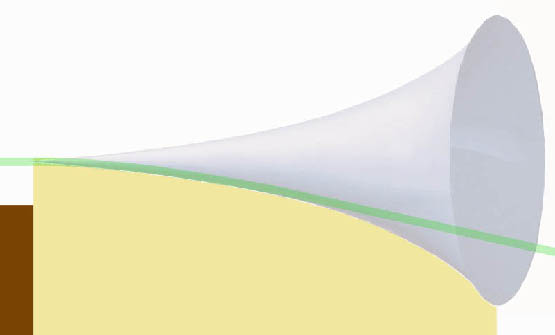
I prefer to shape my slots in the shape of a horn's bell: 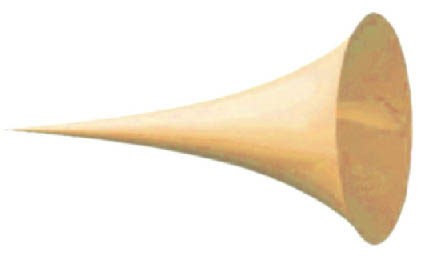 The point of this
is to offer a smooth surface for the string to
travel from the tuning machine to the critical point
of final contact at the front of the slot, where it
is held firmly to define the end of the vibrating
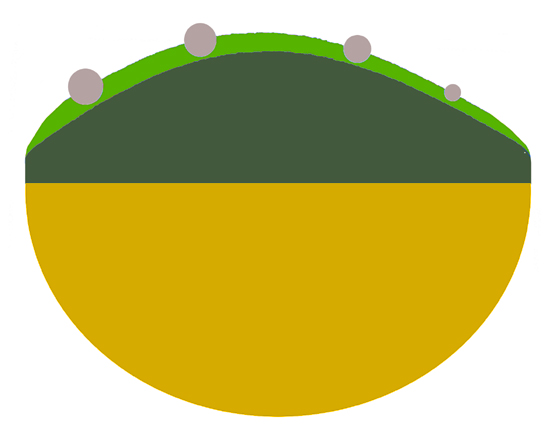
string length. Strings have to make a compound bend at the nut, and to make tuning easiest while ensuring complete firm contact at the front of the slot, this horn bell shape makes certain the string glides smoothly, no matter the angle of approach. Here's a treble side view:
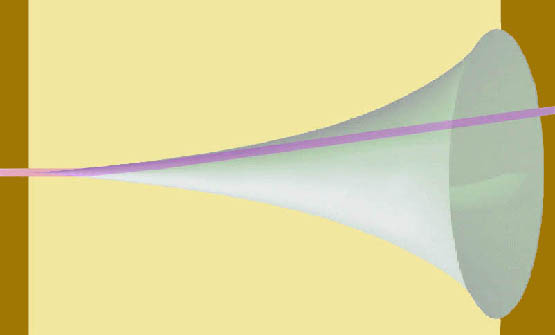
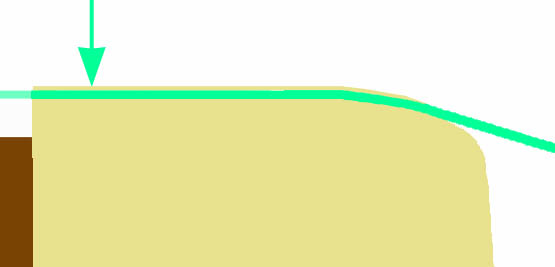
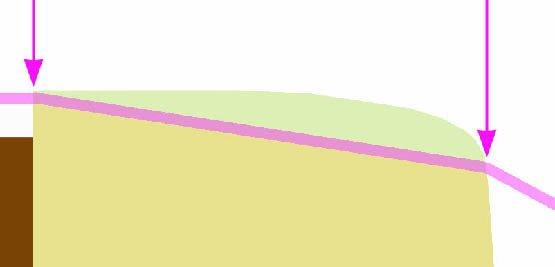
The bell here is imaginary. The nut is in yellow, the fingerboard is dark brown. The string is the green line, and the tuning machines are off to the right somewhere. Notice that the string connects with a smooth curved surface, no corner or edge. Whether the string is coming from the top or the bottom of the string post, it will slide smoothly into the nut slot. The string is in complete contact with the front 30% of the nut. There's plenty of substance there to keep the string from sawing its way deeper into the bone. Here's the same slot seen looking straight down from above:
The string's other curve, from, say, the farthest peg on the bass side of the headstock, also elides with the inside of the bell-shaped slot, guided gently and directly to the front where it's held firmly by its own tension inside the confines of a well cut slot. If the slot isn't
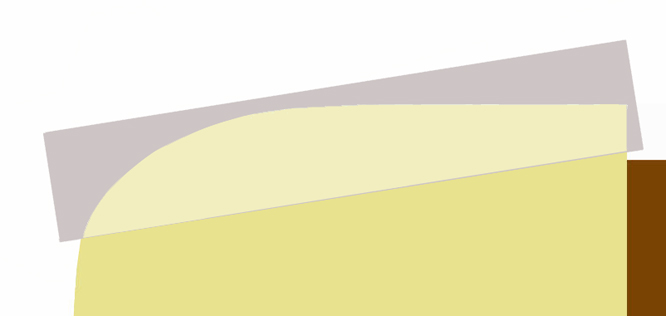
properly angled back, several problems can arise. If it's too flat
(some repair books actually advocate this!) the
string soon wears away the front of the slot and the
functional point of contact is as much a 40% of the
width of the nut back from the front edge,
which can cause the note to ring poorly (because
it's vibrating along a surface, not held to a point)
and perhaps cause intonation problems. This is bad:
If the slot is
angled back, but left a straight line, it will bind
on the back edge, and the front edge will wear down
from playing and the string is at risk for sizzling
on the first fret or on the surface of the board.
This is also bad:
The precise shape
of the slot at the front edge is extremely important
for sound quality, stability of the setup, and
intonation. More on bridges
in due time, but the principles here apply to bridge
slots on the viol and violin families, guitars,
mandolins, and so on. |